


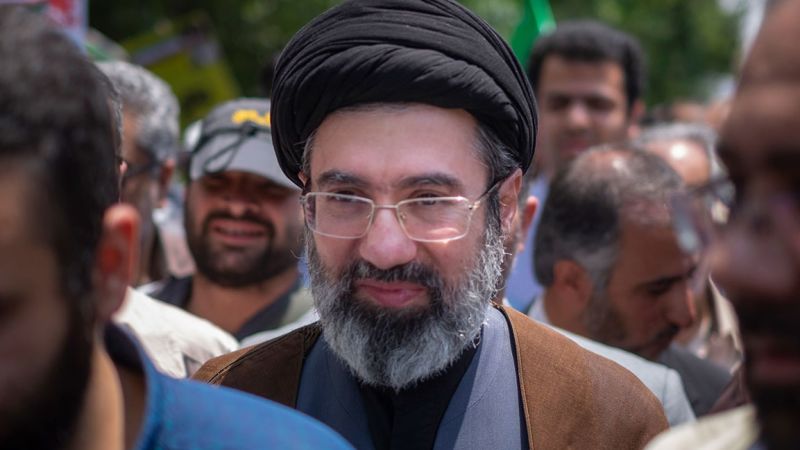
Iran Names Slain Supreme Leader’s Son as Successor, in a Defiant Message to Trump
The Rise of a New Era
Following the death of former Supreme Leader Ali Khamenei in US-Israeli air strikes, Iran’s leadership has chosen his son Mojtaba to assume the highest political and religious office. This decision, announced by the 88-member Assembly of Experts, has sparked debate over the continuation of a dynastic model within the Islamic Republic, despite its 1979 revolution’s initial rejection of such practices.
Mojtaba’s appointment, which solidifies the Khamenei family’s grip on power, is seen as a direct challenge to Western influence. President Donald Trump had previously labeled the younger Khamenei as “unacceptable,” yet the move appears to be a calculated statement of resilience against American pressure. Analysts suggest this signals a broader strategy to reinforce hardline policies and ensure stability amid regional tensions.
“Mojtaba may you die so you don’t assume the leadership role.”
Despite the near-total internet blackout that followed the announcement, state media swiftly began shaping the narrative. A four-minute documentary was released within hours, highlighting Mojtaba’s early life, seminary education, and his service during the Iran-Iraq war at age 17. The clip emphasizes his readiness to lead, countering concerns about his scholarly background by showcasing his political and military experience.
Behind the Scenes: A Quiet Influence
Mojtaba, born in 1969, has long operated in the shadows of his father’s authority. Though he did not attain the rank of Mujtahid, a critical designation for supreme leaders, his ties to the Islamic Revolutionary Guard Corps (IRGC) and economic networks have positioned him as a key player in Iran’s governance. His marriage to Zahra, daughter of Khamenei’s ally Gholam Haddad Adel, further underscores his integration into the regime’s inner circle.

State media resorted to AI-generated videos to fill gaps in Mojtaba’s public presence, revealing his limited visibility before the succession. For years, he remained a silent force, guiding policy from behind the scenes. His growing prominence culminated in 2021 when supporters began promoting him openly as the next leader, a move that highlighted his strategic role within the system.
Historical Context and Political Maneuvering
The 2005 presidential elections marked Mojtaba’s first significant public intervention. He is believed to have leveraged the IRGC’s networks to support Mahmoud Ahmadinejad’s candidacy, a hardliner opposing reformist rivals like Akbar Hashemi Rafsanjani. By 2009, when widespread protests erupted over the re-election of Ahmadinejad, Mojtaba’s influence was evident. Protesters’ chants reflected both his political stature and the regime’s determination to maintain control.
In 2019, Mojtaba faced US sanctions after the Treasury accused him of advancing his father’s “destabilizing regional ambitions and oppressive domestic objectives” through collaboration with the Revolutionary Guards. His ascension to the top position now reinforces the legacy of a leadership that has long prioritized ideological continuity over democratic transition.