


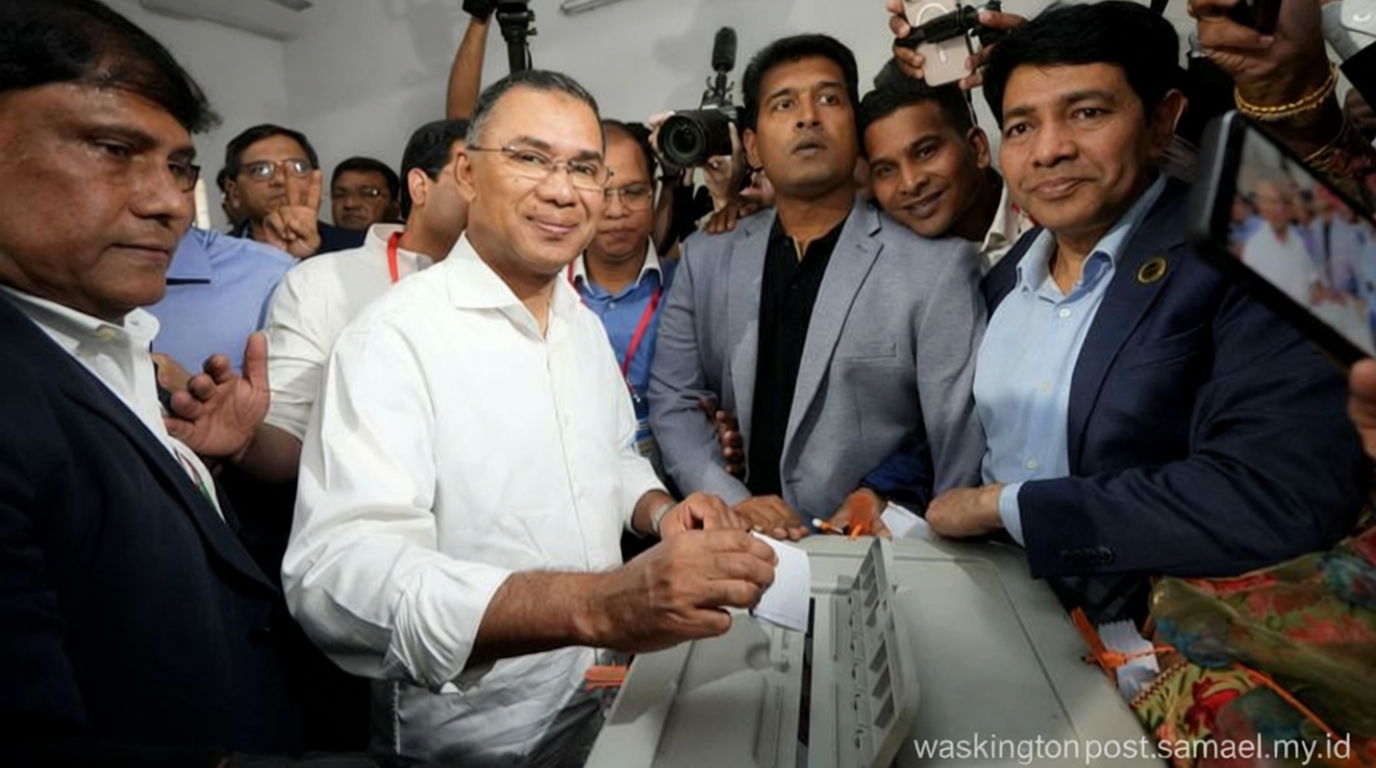
Bangladesh’s BNP Secures Overwhelming Victory in Election, Tarique Rahman Poised for Leadership
After nearly two decades in opposition, Bangladesh’s Bangladesh Nationalist Party (BNP) captured a decisive majority in parliamentary elections held on Friday, signaling a return to power and positioning party leader Tarique Rahman to assume the role of prime minister. The vote, regarded as the nation’s most competitive in years, concluded with the BNP and its allies securing at least 212 of the 299 seats available, according to the Election Commission. This result follows months of widespread protests that destabilized the country under the previous administration of Sheikh Hasina, who resigned in 2024. An interim government led by Nobel laureate Muhammad Yunus has since managed the transition, aiming to restore order amid economic challenges.
Key Challenges Ahead
Rahman, the son of former premier Khaleda Zia and the late president Ziaur Rahman, faces the daunting task of reviving investor trust and revitalizing industries, particularly the garment sector, which is central to Bangladesh’s economy. The nation, the second-largest apparel exporter globally, remains reliant on its manufacturing base, which has suffered during the unrest. “A strong majority gives the BNP the parliamentary strength to pass reforms efficiently and avoid legislative paralysis,” said Selim Raihan, an economics professor at the University of Dhaka. “That alone can create short-term political stability.”
“If the factories run regularly and we get our wages on time, that’s what matters to us. I just want the BNP government to bring back stability so more orders come to Bangladesh and we can survive,” Josna Begum, 28, a garment worker and mother of two, told Reuters.
Gen Z’s Influence and the NCP’s Struggle
While the BNP dominated the results, the National Citizen Party (NCP)—a group of youth activists instrumental in toppling Hasina—won only five of the 30 seats it contested. The NCP’s underwhelming showing suggests that voter sentiment has shifted, favoring established political figures over younger leaders. “Gen Z won the revolution,” the article noted, “but the old guard are dominating the election.”
International Reactions and Regional Dynamics
Rahman’s victory was quickly acknowledged by global leaders, including Indian Prime Minister Narendra Modi, Pakistani Prime Minister Shehbaz Sharif, and U.S. Ambassador Brent T. Christensen. However, the election also reignited debates about regional influence, with the U.S. ambassador expressing concern over growing Chinese involvement in Bangladesh. Meanwhile, India and China have intensified their competition for sway in the Muslim-majority nation of 175 million, as ties with New Delhi have deteriorated since Hasina fled to India.

The Jamaat-e-Islami, a key opposition party, conceded defeat late on Thursday but claimed dissatisfaction with the election process in a statement issued on Friday. The party’s tally of 70 seats in parliament marks its highest since being banned in 2013, a measure lifted after Hasina’s departure. The BNP’s 212-seat majority is its largest since 2001, when it secured 193 seats, though Hasina’s Awami League had previously held 230 seats in 2008. Earlier elections were either boycotted or marked by disputes, making this year’s outcome a pivotal moment for Bangladesh’s political recovery.
Turnout in Thursday’s vote exceeded 42%, surpassing the participation rate of the 2024 election. With nearly 60% of registered voters casting ballots, the results underscore a renewed engagement in the political process as the country seeks to stabilize its future.